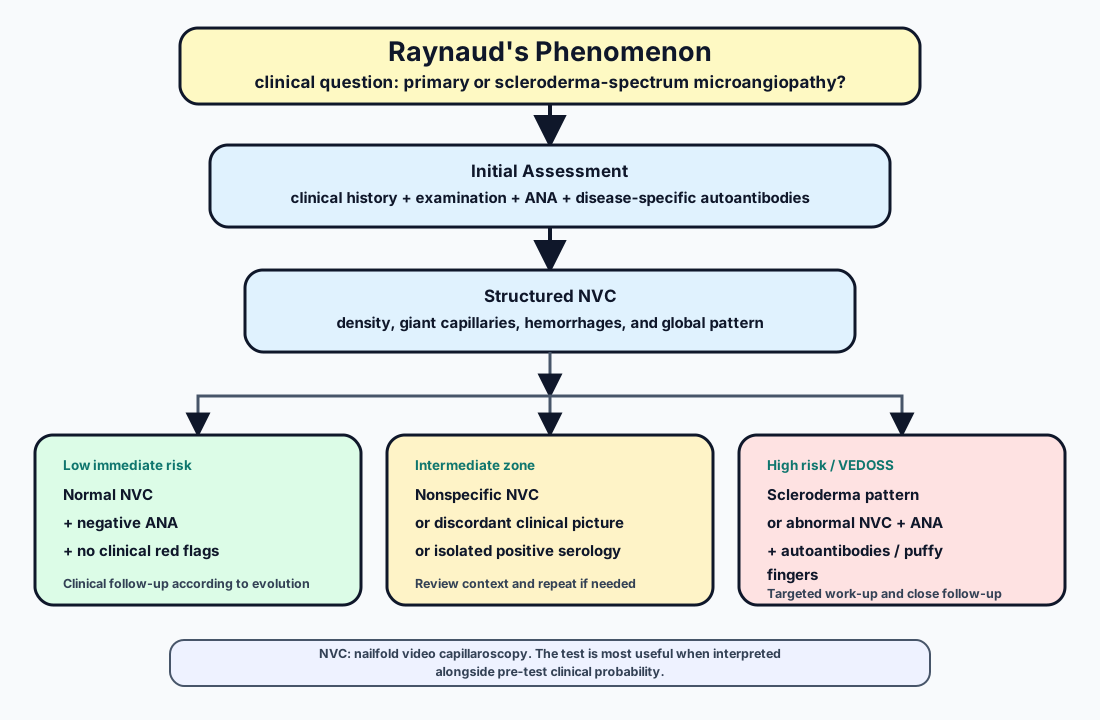
The classic indication for capillaroscopy, especially nailfold video capillaroscopy (NVC), is the assessment of Raynaud's phenomenon and suspected systemic sclerosis. Outside this setting it can also be useful, but its value varies according to the disease and the prior clinical probability; it must also be interpreted alongside serology, physical examination, and follow-up [1, 2].
- The strongest indication is a patient with Raynaud's phenomenon in whom a primary form must be distinguished from secondary microangiopathy [1, 2].
- The technique provides diagnostic, classification, and prognostic value in systemic sclerosis and very early states of the scleroderma-spectrum disease [1, 3, 4, 5].
- In systemic sclerosis, reduced density and advanced patterns are associated with greater vascular burden, including a history of digital ulcers [5, 6].
- In inflammatory myopathies, evidence is promising, especially in dermatomyositis, although it is still less extensive than in systemic sclerosis [8, 9].
- In vasculitis, primary biliary cholangitis (PBC), or other less common settings, the indication should be selective: evidence is heterogeneous, often nonspecific, and does not justify indiscriminate screening with this procedure [10, 11, 12, 13, 14].
Learning path
If you want to decide when requesting capillaroscopy is worthwhile and which clinical question it should answer, start here. It will then be useful to go deeper into Raynaud's phenomenon, the scleroderma pattern, criteria, and classification, prognosis, digital ulcers, and longitudinal follow-up, and other vascular acrosyndromes to apply these indications to specific scenarios.
Scenarios best supported by evidence
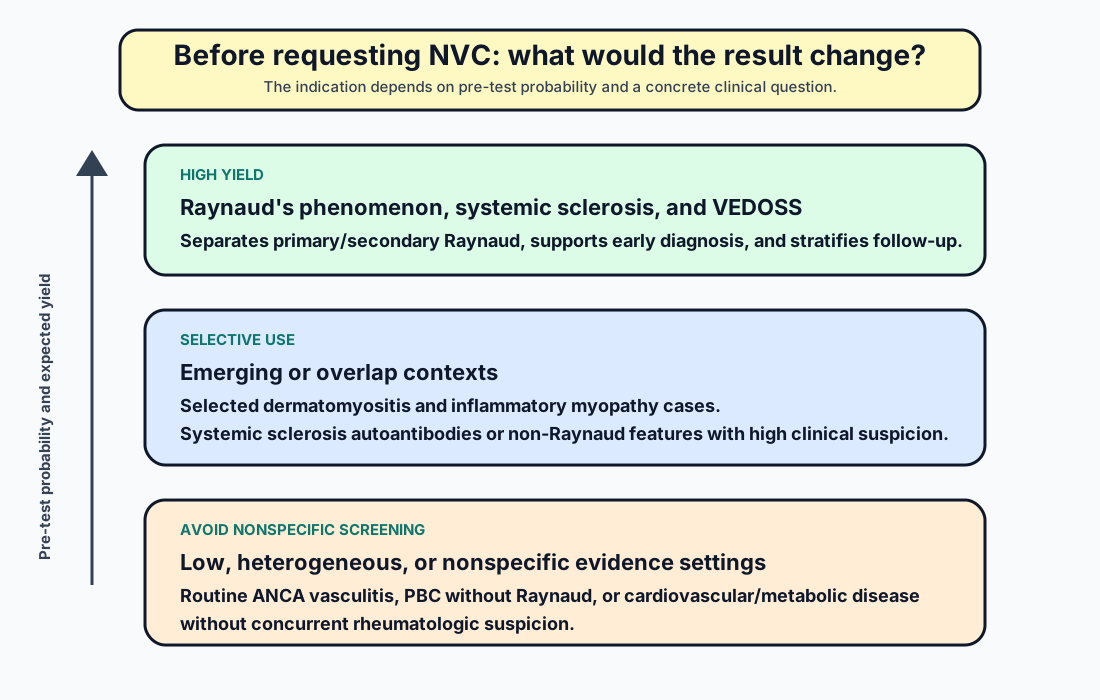
The first question is not whether capillaroscopy can be performed, but which clinical decision would change if the result is normal, nonspecific, or clearly scleroderma-pattern.
| Scenario | What the test can answer | Strength of evidence | Key limitation |
|---|---|---|---|
| Raynaud's phenomenon | Guide the distinction between primary and secondary forms and detect scleroderma-pattern microangiopathy | High [1, 2] | It should not be interpreted without accompanying serology and clinical context [1, 14] |
| Systemic sclerosis and very early diagnosis | Support early diagnosis, classification, and risk stratification | High [1, 3, 4, 5] | Isolated findings do not replace clinical criteria [3, 4] |
| Digital ulcers in systemic sclerosis | Characterize microvascular burden and support vascular prognosis | Moderate [1, 6] | Prospective prognostic evidence remains incomplete [6] |
| Dermatomyositis and other inflammatory myopathies | Support phenotyping and follow-up in selected cases | Moderate-emerging [8, 9] | Less standardization and greater heterogeneity between diseases [8, 9] |
| Vasculitis, PBC, less common contexts | Raise suspicion in highly selected scenarios | Low or insufficient [10, 11, 12, 13] | Not suitable as a universal screening tool [10, 11, 12, 13, 14] |
When to request it in practice
- Recent-onset Raynaud or Raynaud with atypical features.
- Raynaud associated with antinuclear antibodies (ANA), specific autoantibodies, puffy fingers, or skin thickening.
- Suspected systemic sclerosis, even if not all criteria are met [3, 4, 5].
- Dermatomyositis or antisynthetase syndrome when reinforcing the vascular phenotype or monitoring evolution is relevant [8, 9].
- Selected situations with organ-dominant autoimmune disease and concomitant Raynaud, for example PBC with suspected scleroderma overlap [12].
Raynaud and systemic sclerosis
This is the core setting of maximum clinical utility: the place where capillaroscopy changes the most diagnostic and follow-up decisions.
Raynaud's phenomenon: the main indication
Recent reviews still place Raynaud's phenomenon as the clearest indication. Capillaroscopy does not only look for a scleroderma pattern; it also helps separate normality from nonspecific abnormalities and determine the intensity of follow-up [1, 2]. Combination with ANA and specific autoantibodies is especially relevant in early phases [1, 4].
In the Very Early Diagnosis of Systemic Sclerosis (VEDOSS) strategy, overall progression to systemic sclerosis was 52.4% at five years among patients who progressed or completed follow-up, but reached 94.1% when positive ANA, specific autoantibodies, and puffy fingers coexisted [4]. In another cohort of early systemic sclerosis, an active or late baseline pattern was associated with development of definite disease at three years [5].
Systemic sclerosis: early diagnosis and vascular burden
Capillaroscopy is already part of the 2013 ACR/EULAR (American College of Rheumatology / European Alliance of Associations for Rheumatology) classification criteria and helps recognize very early disease when clinical features are still incomplete [3]. As density decreases and the pattern progresses, suspicion increases for structural vasculopathy with clinical consequences [1, 3, 4, 5, 6].
| Clinical question | What capillaroscopy adds | Useful point |
|---|---|---|
| Could this Raynaud be secondary? | Detects scleroderma pattern or significant changes in density or hemorrhages | Most useful when integrated with ANA and autoantibodies [1, 2, 4] |
| Is very early systemic sclerosis progressing? | Quantifies transition toward active or late patterns | In one cohort, active or late baseline pattern was associated with definite systemic sclerosis at 3 years [5] |
| Is there greater digital vascular risk? | Identifies edema, density loss, and late pattern | In SCLEROCAP, late pattern was associated with a history of digital ulcer on the same finger [6] |
The SCLEROCAP study showed an association between history of digital ulcer and late pattern, edema, and lower capillary density on the same finger. This is clinically important, although it does not yet support a universal ready-to-use prognostic algorithm because additional prospective validation is lacking [6].
Emerging contexts and limitations
Here it is important to define the gray zones: inflammatory myopathies, organ-dominant autoimmune diseases, vasculitis, and cardiovascular or metabolic contexts.
Inflammatory myopathies: promising, but not as consolidated as systemic sclerosis
A structured review by the European Alliance of Associations for Rheumatology (EULAR) study group on microcirculation concluded that NVC is a promising tool in dermatomyositis and inflammatory myopathies, especially because lower density or a scleroderma pattern is associated with disease activity, but it also emphasized the need for confirmation in standardized multicenter studies [8]. In a multicenter, multiethnic cohort of 155 patients with inflammatory myopathies, only 9% had normal NVC; the scleroderma pattern was observed mainly in dermatomyositis and overlap myopathy, and several variables improved after disease control [9].
In short, selective use is justified: it can help reinforce the vascular phenotype, raise suspicion for dermatomyositis or overlap disease, and monitor some patients, but it still lacks the same methodological maturity seen in systemic sclerosis [8, 9].
Patients without Raynaud or with organ-dominant manifestations
NVC can also be useful outside classic Raynaud when suspicion of systemic sclerosis is high before the test. In patients with indeterminate non-Raynaud features or systemic sclerosis autoantibodies, an Australian cohort found that a baseline scleroderma pattern was associated with development of scleroderma-spectrum disease; in that context, the negative predictive value was 86.7% [7].
In PBC, a cross-sectional study of 56 patients found abnormalities in 55%, but only 5% showed a scleroderma pattern, and the two new systemic sclerosis diagnoses occurred in patients with Raynaud; no patient without Raynaud was diagnosed with systemic sclerosis [12]. The practical conclusion is clear: in organ-dominant contexts, the test seems more reasonable as an extension of an autoimmune phenotype with Raynaud than as indiscriminate general screening [7, 12].
Vasculitis and other non-classic diseases
Here the evidence is inconsistent. A 2024 review on antineutrophil cytoplasmic antibody (ANCA)-associated vasculitis summarizes that the literature describes nonspecific abnormalities in 70%-80% of some groups with active disease, but acknowledges that these findings are heterogeneous and still insufficient for routine use [11]. In contrast, a case-control study of 33 patients with ANCA-associated vasculitis found no significant differences versus controls in density, dilation, morphology, or hemorrhages [10].
Something similar occurs in cardiovascular and metabolic disease: a systematic review found multiple associations between NVC and cardiovascular disease, but also highlighted its low specificity outside the rheumatology context [13]. Therefore, the technique should not be used as a universal biomarker of vascular damage without a concrete diagnostic question.
Checklist to justify an NVC indication
- Define whether the question is diagnostic, prognostic, or related to follow-up.
- Confirm whether Raynaud, puffy fingers, autoantibodies, or signs of the scleroderma spectrum are present [3, 4].
- In inflammatory myopathies, clarify whether the test is intended to support phenotype, activity, or associated vascular damage [8, 9].
- Avoid ordering it as a nonspecific marker of systemic vascular disease [10, 11, 12, 13, 14].
- In less common contexts, document why the result would change management or follow-up.
FAQ
What is the most important indication?
The assessment of Raynaud's phenomenon, especially when there is uncertainty about primary versus secondary origin [1, 2].
Can it diagnose systemic sclerosis by itself?
Not by itself. It is a very relevant tool within criteria and the VEDOSS approach, but it requires clinical and serological context [3, 4].
When does it have prognostic value?
Mainly in systemic sclerosis and very early scleroderma-spectrum disease, where pattern progression and density loss provide risk information [4, 5, 6].
Can it be useful if the patient does not have Raynaud?
Yes, but not always. In patients with non-Raynaud features suggesting systemic sclerosis or specific autoantibodies it can help; outside that context, yield is much lower [7, 12].
What is its role in dermatomyositis screening?
Promising, especially for vascular phenotyping and activity, although evidence remains less solid than in systemic sclerosis [8, 9].
Should I order it in ANCA-associated vasculitis?
Not routinely. Evidence is exploratory and conflicting, with recent studies failing to demonstrate a capillaroscopic phenotype useful for general clinical diagnosis [10, 11].
Does it make sense as PBC screening?
Only in a targeted way, especially if Raynaud or clinical suspicion of overlap with systemic sclerosis is documented [12].
Glossary
- Raynaud's phenomenon
- Episodic digital vasospasm, primary or secondary, whose distinction is one of the main indications for NVC.
- NVC
- Nailfold video capillaroscopy.
- VEDOSS
- Very Early Diagnosis of Systemic Sclerosis strategy combining clinical features, autoantibodies, and NVC.
- Late pattern
- Advanced phase of the scleroderma pattern, with density loss and disorganized neoangiogenesis.
- Idiopathic inflammatory myopathies
- Group including dermatomyositis, antisynthetase syndrome, and other subtypes in which NVC may provide complementary vascular information.
- Pre-test probability
- Initial clinical probability that disease is present before testing; it determines how much NVC can help confirm or rule out a specific suspicion.
References
- Smith V, Ickinger C, Hysa E, Snow M, Frech T, Sulli A, et al. Nailfold capillaroscopy. Best Pract Res Clin Rheumatol. 2023;37(1):101849. doi: 10.1016/j.berh.2023.101849. PMID: 37419757.
- Roberts-Thomson PJ, Patterson KA, Walker JG. Clinical utility of nailfold capillaroscopy. Intern Med J. 2023;53(5):671-679. doi: 10.1111/imj.15966. PMID: 36353844.
- van den Hoogen F, Khanna D, Fransen J, Johnson SR, Baron M, Tyndall A, et al. 2013 classification criteria for systemic sclerosis: an American College of Rheumatology/European League Against Rheumatism collaborative initiative. Arthritis Rheum. 2013;65(11):2737-2747. doi: 10.1002/art.38098. PMID: 24092682.
- Bellando-Randone S, Del Galdo F, Lepri G, Czirják L, Denton CP, Guiducci S, et al. Progression of patients with Raynaud's phenomenon to systemic sclerosis: a five-year analysis of the European Scleroderma Trial and Research group multicentre, longitudinal registry study for Very Early Diagnosis of Systemic Sclerosis (VEDOSS). Lancet Rheumatol. 2021;3(12):e834-e843. doi: 10.1016/S2665-9913(21)00244-7. PMID: 38287630.
- Zumstein Camargo C, Kayser C. Capillaroscopy changes are associated with disease progression in patients with early systemic sclerosis: a prospective study. Int J Rheum Dis. 2019;22(7):1319-1326. doi: 10.1111/1756-185X.13592. PMID: 31050209.
- Boulon C, Velardo F, Blaise S, Mangin M, Decamps-Le Chevoir J, Senet P, et al. Correlation of nailfold capillaroscopy findings with history of digital ulcer on same finger: Results of SCLEROCAP study. Microvasc Res. 2022;142:104365. doi: 10.1016/j.mvr.2022.104365. PMID: 35367233.
- Hong C, Xiang L, Saffari SE, Low AHL. Nailfold capillaroscopy for the early diagnosis of the scleroderma spectrum of diseases in patients without Raynaud's phenomenon. J Scleroderma Relat Disord. 2022;7(2):144-150. doi: 10.1177/23971983221088460. PMID: 35585956.
- Piette Y, Reynaert V, Vanhaecke A, Bonroy C, Gutermuth J, Sulli A, et al. Standardised interpretation of capillaroscopy in autoimmune idiopathic inflammatory myopathies: a structured review on behalf of the EULAR study group on microcirculation in Rheumatic Diseases. Autoimmun Rev. 2022;21(6):103087. doi: 10.1016/j.autrev.2022.103087. PMID: 35421608.
- Torres-Ruiz J, Pinal-Fernández I, Selva-O'Callaghan A, Campbell B, Muñoz-Braceras S, Mejía-Domínguez NR, et al. Nailfold capillaroscopy findings of a multicentric multi-ethnic cohort of patients with idiopathic inflammatory myopathies. Clin Exp Rheumatol. 2024;42(2):367-376. doi: 10.55563/clinexprheumatol/l9gudh. PMID: 38488092.
- Sullivan MM, Abril A, Aslam N, Ball CT, Berianu F. Nailfold videocapillaroscopy in antineutrophil cytoplasmic antibody-associated vasculitis. Arthritis Res Ther. 2024;26(1):4. doi: 10.1186/s13075-023-03227-z. PMID: 38167073.
- Screm G, Mondini L, Confalonieri P, Salton F, Trotta L, Barbieri M, et al. Nailfold Capillaroscopy Analysis Can Add a New Perspective to Biomarker Research in Antineutrophil Cytoplasmic Antibody-Associated Vasculitis. Diagnostics (Basel). 2024;14(3):254. doi: 10.3390/diagnostics14030254. PMID: 38337770.
- Crescenzi D, Balducci D, Mazzetti M, Menghini D, Gelardi C, Pedini V, et al. Use of nailfold capillaroscopy for the early diagnosis of systemic sclerosis in patients with primary biliary cholangitis. Ann Gastroenterol. 2025;38(2):187-194. doi: 10.20524/aog.2025.0949. PMID: 40124434.
- Lim MWS, Setjiadi D, Dobbin SJH, Lang NN, Delles C, Connelly PJ. Nailfold video-capillaroscopy in the study of cardiovascular disease: a systematic review. Blood Press Monit. 2023;28(1):24-32. doi: 10.1097/MBP.0000000000000624. PMID: 36281701.
- Amaral MC, Seguro Paula F, Caetano J, Ames PRJ, Delgado Alves J. Re-evaluation of nailfold capillaroscopy in discriminating primary from secondary Raynaud's phenomenon and in predicting systemic sclerosis: a randomised observational prospective cohort study. Expert Rev Clin Immunol. 2024;20(6):665-672. doi: 10.1080/1744666X.2024.2313642. PMID: 38465507.